
What to Wear to a Spanish Wedding: The Valencia Guest Dress Code Explained
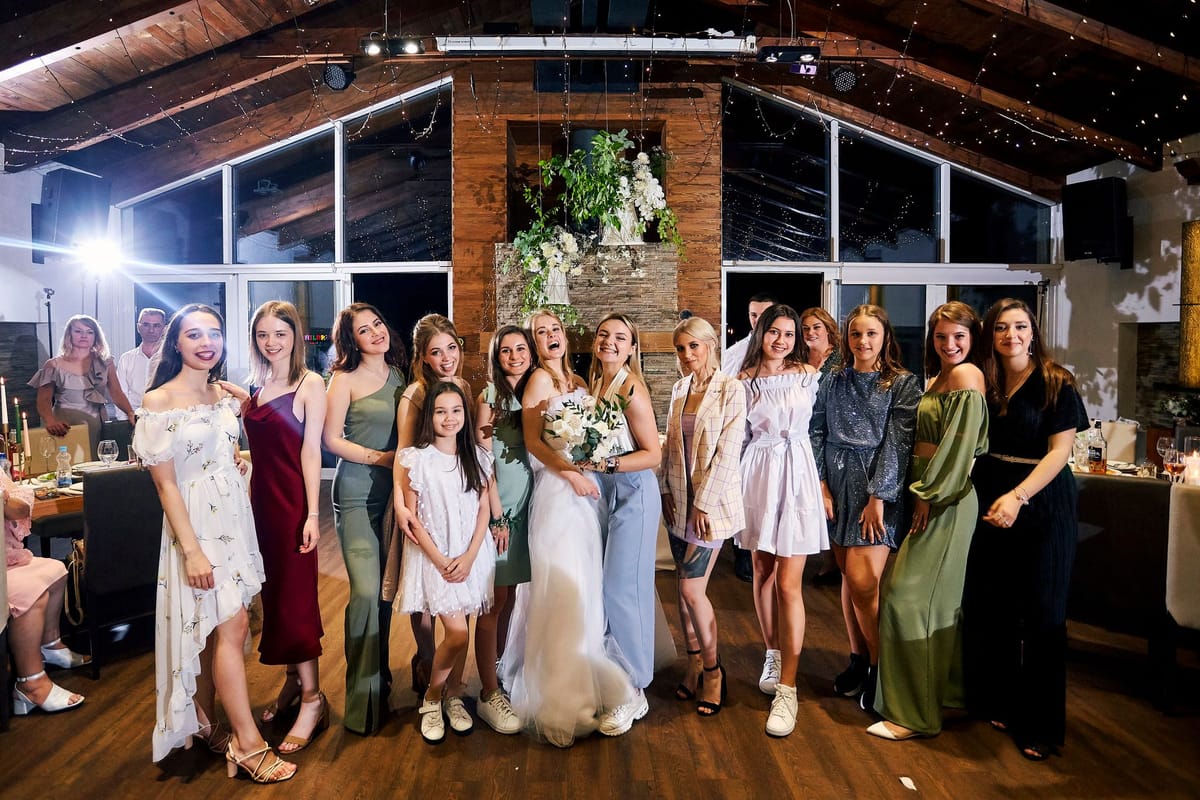
The short version: skip white, ivory and anything close to it (that's the bride's colour, full stop), skip black before evening, and let the ceremony's start time, not a dress code printed on the invitation, decide how long your dress should be. British and American wedding etiquette shares some of these instincts, but the details diverge in ways that catch anglophone guests out every summer. Here's what actually changes when you're invited to a boda near Valencia.
Which colours should you avoid at a Spanish wedding?
The headline rule is the one you already know: white and its close cousins belong to the bride. Beyond that, colour etiquette in Spain is stricter and more time-sensitive than most British or American guests expect. Here's what raises eyebrows, and why.
| Colour | Why it's avoided |
|---|---|
| White, ivory, ecru, very pale champagne or nude | Reserved for the bride: this is protocol mistake number one. |
| Black before evening | Associated with mourning at a daytime boda. Perfectly fine at a night wedding, ideally lifted with colourful or metallic accessories. |
| Red | Seen as trying to upstage the bride. |
| Neon (bright green, flashy fuchsia) | Considered too attention-grabbing. |
| The bridesmaids' colour | Ask ahead: you don't want to blend into the wedding party. |
How does this compare to a British or American wedding?
This is where a Spanish boda genuinely differs from what you've grown up with, and it's worth spelling out rather than assuming your usual wedding-guest instincts will transfer.
- The "no white" rule exists everywhere, but enforcement is stricter in Spain. British and American etiquette also frowns on a guest wearing white, but plenty of American weddings tolerate a pale, clearly-not-bridal dress. In Spain, even a very light nude or champagne shade can draw comment: when in doubt, go darker.
- Black is treated very differently. In the UK and US, black is a safe, common choice for a wedding at almost any time of day, cocktail-dress-code invitations often suggest it outright. In Spain, black before evening reads as mourning at a daytime boda; save it for a night wedding.
- Hats work on a different clock. British weddings have a strong daytime hat and fascinator tradition, largely detached from the hour, a smart hat is normal at a midday church service or a 4pm reception alike. American weddings barely have a hat culture for guests at all. In Spain, the pamela (a wide-brimmed sun hat) is a daytime, outdoor accessory tied specifically to sunlight, not formality: it comes off once the sun does, in general by early evening.
- There's no real anglophone equivalent to the mantilla. The lace veil over a peineta comb isn't a hat substitute or a fashion statement, it's a protocol role reserved for the groom's mother or godmother at a religious boda. There's nothing quite like it in British or American wedding guest etiquette, so the safest approach is simply not to wear one unless you've been asked to.
- Timing runs later, and it drives the whole outfit. A British wedding typically wraps its formal part by mid-evening and a US reception often ends by 10 or 11pm. A Spanish boda, especially an evening one, routinely runs to 3 or 4am. That's also why a comfortable pair of flat shoes to change into partway through the night is a genuinely common local habit, not just a cliché.
- The invitation rarely states a dress code. Many UK and US invitations spell one out ("black tie", "smart casual", "cocktail attire"). Spanish invitations usually don't, the ceremony's start time is the dress code. If you're unsure, ask what time the church or town hall ceremony begins, not what to wear.
Morning, afternoon or night: how timing changes your outfit
This is the Spanish reflex that anglophones most often miss: the outfit is set by the ceremony's start time, not by a stated dress code. A morning ceremony (often religious) doesn't call for the same dress as a boda de noche. One nuance worth keeping: even for a tarde (late afternoon, often civil) wedding, a long dress is fine without tipping into full evening wear.
| Time of day | Dress | Accessories and details |
|---|---|---|
| Morning / daytime | Short to midi length (knee-length is a safe bet) | Lower heels, understated make-up, a pamela is an option |
| Late afternoon (tarde) | Long is fine, but stop short of full evening wear; a smart jumpsuit or trousers also work | Dressy, without going overboard |
| Night | Long, ankle-length or asymmetric | Black and metallics welcome, higher heels (10 to 12cm), more elaborate make-up, no pamela |
Pamela or mantilla: what actually goes on your head?
The two get mixed up constantly, wrongly. The pamela is a wide-brimmed hat with a practical, sun-blocking purpose: worn by day, outdoors (a garden, a beach ceremony), broadly until 6pm and mostly from March to October. It's a perfectly ordinary guest accessory. Once the sun goes down, there's nothing left to filter, so it comes off.
The mantilla (a lace veil worn over a peineta comb) is a different matter entirely. It is not a general guest accessory. It's traditionally reserved for the madrina (the groom's mother, or godmother) at a religious boda only, and it's never appropriate at a civil ceremony. You'll also see it in black during Holy Week, and in white for christenings, first communions or papal audiences. In short: unless you've been given that specific protocol role, it isn't for you. A guest turning up in a mantilla isn't making a charming nod to tradition, they're making a genuine faux pas.
Where to shop for a wedding guest outfit in Valencia
Good news: the city has you covered for both the dress and the headwear. For a complete invitada (wedding guest) outfit, the go-to name is THE-ARE (the label founded by Rocío Botella), at Carrer Comte de Salvatierra 25 in the Eixample district. This recently opened flagship focuses specifically on occasionwear and the "perfect wedding guest" look, dresses and accessories together. Opening hours: Monday to Saturday 10am to 9pm, Sundays and public holidays 11am to 8pm (closed Sundays in July, August and September).
Another upmarket women's fashion address, known for a clean style and free alterations, is Charo Navarro, Calle Cirilo Amorós 44. Worth knowing: it's a general womenswear boutique, its reputation as a specialist "wedding guest" address isn't confirmed, so check in person.
For a pamela or a made-to-order tocado (headpiece), Entrecostura (Avenida del Poeta Emilio Baró 57, Monday to Friday 10am to 8.30pm, Saturday 10am to 2pm) makes handcrafted tocados, pamelas and hats for weddings. Two useful caveats: Sombreros Albero (Calle Xàtiva 21) is real and worth knowing about, but its official speciality is menswear hats, not women's pamelas. And Carmen Ortí Tocados y Pamelas, a made-to-measure, appointment-only atelier, is based in Torrent, a neighbouring town, not in Valencia city itself. Want to dig further into the local fashion scene? See our guide to Valencia's fashion and jewellery brands, and for the wider unwritten rules of socialising here, our piece on Spain's small social codes.
FAQ
Can I wear black to a Spanish wedding?
Yes, but only in the evening. During the day, black is still associated with mourning and best avoided at a boda; at night, it's entirely acceptable, ideally paired with colourful or metallic accessories.
Is a pamela compulsory?
No, it's never compulsory. It's a daytime accessory with a practical sun-blocking role, suited to outdoor ceremonies (roughly March to October, until early evening). It isn't worn at night.
What's the difference between a pamela and a mantilla?
A pamela is an ordinary wide-brimmed sun hat any daytime guest can wear. A mantilla is a lace veil with a specific protocol role, reserved for the groom's mother or godmother at a religious ceremony, never for an ordinary guest and never at a civil wedding.
What if I don't know the exact ceremony time?
Ask the couple or a close relative: in Valencia, the time sets the outfit. A morning wedding calls for a shorter dress and lower heels; a night wedding calls for a long dress and more elaborate make-up.
Sources
Sources: Hola.com (dress code by time of day, May and June 2026), bodas.com, bodas.net, wedded.app, InOutModa, Ybela, El Taller de Regina (colours, pamela and mantilla); the-are.com and FashionNetwork (THE-ARE); entrecostura.com (Entrecostura); visitvalencia.com (Sombreros Albero); carmenorti.com and bodas.net (Carmen Ortí). Opening hours and addresses can change: double-check before you go.
Information verified in July 2026. The Daily Valencia is an AI-assisted publication with human editorial review before anything goes live.
Le Livre blanc 2026 de l'expat à Valencia
NIE, empadronamiento, fiscalité, école, logement : tout l'essentiel pour s'installer, réuni dans un guide PDF. Laisse ton e-mail, on te l'envoie.
🎉 Et voilà ! Ton Livre blanc 2026 de l'expat s'ouvre ici :
Ouvrir le Livre blanc 2026Dernière étape pour rejoindre l'aventure : confirme ton inscription dans l'e-mail qu'on vient de t'envoyer.
Réagis à cet article