
Valencia's century-old trees: the giant ficus of the Glorieta and Parterre
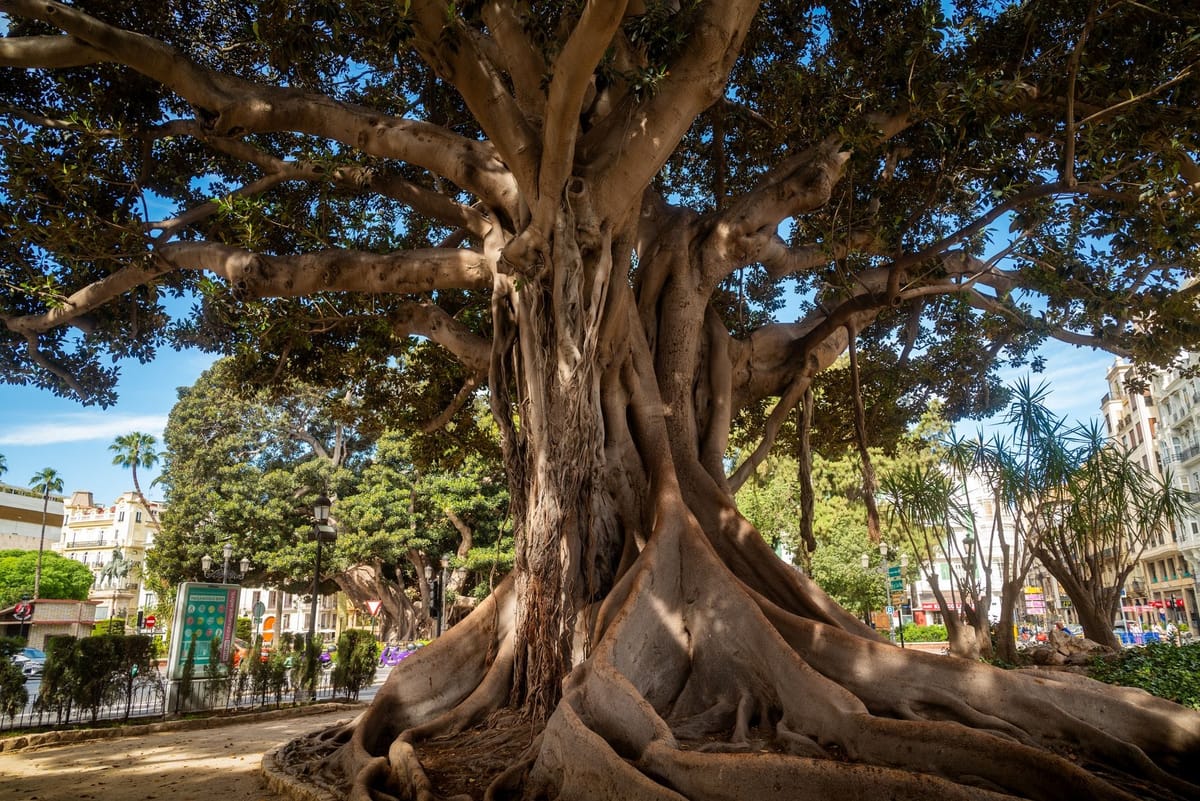
Because in 1852, gardeners in Valencia accidentally planted Australian fig trees instead of magnolias in two city-centre gardens, the Parterre and the Glorieta. Those trees then had more than 170 years to grow the huge aerial roots you can touch or simply admire today, and they are far from the city's only remarkable trees: Valencia counts several dozen specimens listed as monumental or singular by the regional government.
The short version: what should you remember?
The ficus of the Glorieta and the Parterre were planted by mistake in 1852, mixed in with a batch of 47 magnolias. The Parterre fig tree stands 24 metres tall and covers about 850 m² of ground, according to Valencia Plaza. These trees survived two major storms (1915 and 1916) and the 1957 Turia flood. Other remarkable trees grow at the Torres de Serranos, the Jardines del Real and the Botanical Garden. An official regional register, created by regional law 4/2006, protects the monumental and singular trees of the Comunitat Valenciana, which held 2,439 of them at its last update on 23 March 2023.
| Marker | Figure | Source |
|---|---|---|
| Species of the giant figs | Ficus macrophylla (Moreton Bay fig), native to Australia | Valencia Plaza |
| Parterre fig tree | 24 metres tall, about 850 m² of ground cover | Valencia Plaza |
| Planting (by mistake) | 1852, mixed in with 47 magnolias | Valencia Bonita, Valencia Plaza |
| Protected trees in the Comunitat Valenciana | 2,439 specimens (update of 23 March 2023) | Generalitat Valenciana, CIEF |
What are these giant-rooted trees at the Glorieta and the Parterre?
They are Ficus macrophylla, also known as Moreton Bay figs, a species native to the east coast of Australia. The one at the Parterre, on Plaça d'Alfons el Magnànim, is the most impressive of the four: it is 24 metres tall and covers around 850 m² of ground, according to Valencia Plaza. Three other specimens, its "brothers", grow just across the way in the Glorieta park, in front of the Tribunal Superior de Justicia, the former Aduana (customs house) of Valencia built in the late 18th century.
| Fig tree | Where | Locate |
|---|---|---|
| Parterre fig tree | Plaça d'Alfons el Magnànim | |
| The three "brothers" | Glorieta park |
How did these fig trees end up in Valencia by mistake?
They were planted in 1852 alongside 47 magnolias, according to Valencia Bonita and Valencia Plaza. The gardeners of the time, fooled by how alike the young plants of the two species looked, mixed a few figs into the batch of magnolias without realising it. A century and a half later, the result is trees far larger than anyone planned: the Parterre trunk even settled onto that square before the statue of Jaume I that now stands at its feet.
What ordeals have these century-old trees been through?
Plenty: two monarchies, two Republics, a dictatorship, a civil war and at least two major storms, according to Valencia Secreta and Valencia Bonita. The Parterre fig withstood hurricane-force wind in 1915, the Glorieta one a similar episode in 1916. Both also survived the 1957 Turia flood, when the water rose close to their crowns.
| Ordeal | Year | What happened |
|---|---|---|
| Planting (by mistake) | 1852 | Figs mixed in with 47 magnolias at the Parterre and Glorieta |
| Storm at the Parterre | 1915 | Violent wind, the tree holds firm |
| Storm at the Glorieta | 1916 | Another wind episode, the figs stand fast |
| Turia flood | 1957 | The water almost reaches the treetops |
| Branch fall at the Parterre | September 2022 | A branch collapses with no injuries, according to El Debate |
Where else can you see remarkable trees in Valencia?
Almost everywhere, in fact. According to El Debate and Valencia Bonita, you will find large century-old figs at the Beneficencia, the Torres de Serranos, on Gran Vía Marqués del Turia, in the Jardines de Ayora, and in the courtyard of the Corts Valencianes, the regional parliament, where one specimen reaches 22 metres. Other remarkable trees, without being figs, are also worth the detour, a reminder that Valencia stays a very green city, ringed by its historic huerta farmland.
| Place | Remarkable tree | Locate |
|---|---|---|
| Plaza de la Legión Española | Large fig, near the old Turia riverbed | |
| Jardines del Real (Viveros) | Fig known as "de la condesa de Ripalda", planted in 1891 | |
| Botanical Garden of the University | Zelkova carpinifolia, 33 metres tall, 5.27 m in girth | |
| Corts Valencianes | Fig reaching 22 metres tall, in the parliament courtyard | |
| Old Campanar pine grove | Pine about 150 years old, last remnant of the forest that once ringed Valencia | Campanar |
| Avenida del Cid (start of Calle Albacete) | Three century-old palms, remnants of a former estate | Av. del Cid |
Are these trees officially protected?
Yes, some are, through the Catálogo de Árboles Monumentales y Singulares de la Comunitat Valenciana, an official register run by the Forestry Research and Experimentation Centre (CIEF) of the Generalitat Valenciana, created by regional law 4/2006. A tree can be added on three main criteria: trunk girth, an age of 500 years or more for certain species, or a monumentality coefficient calculated by CIEF technicians. Town councils can also propose that a tree be declared "monumental of local interest". At its last update, on 23 March 2023, the regional catalogue held 2,439 specimens, making the Comunitat Valenciana the Spanish region with the most protected trees, according to the Generalitat Valenciana.
Has the Parterre fig ever been under threat?
Yes, from a petrol station installed right next to it. Its roots grew to the point of threatening the fuel tanks and lifting the nearby pavements, according to Valencia Bonita. Talks to move the station began in 2014 and reached an agreement in 2019. The installations were fully dismantled in 2020 according to Valencia Bonita, though Valencia Secreta places that step in 2022; either way, both sources agree the station was indeed removed to protect the tree. A report once valued the tree at around 380,000 euros, a figure Valencia Bonita itself calls far below its sentimental value to the neighbourhood.
Frequently asked questions about Valencia's century-old trees
Can you climb on the roots of the Glorieta and Parterre figs?
Many Valencians did as children and still sit on them or take photos. These are, however, trees protected as city heritage: it is best to go easy on the thinnest roots and avoid damaging the bark.
Why do these figs have such huge, visible roots at ground level?
The Ficus macrophylla naturally develops wide buttress roots, a kind of fin, to stabilise its massive trunk and broad crown. With 170 years of growth in urban soil, those roots have ended up lifting the surrounding pavement.
How many trees are listed as monumental in the Comunitat Valenciana?
The regional catalogue held 2,439 at its last update, on 23 March 2023, according to the Generalitat Valenciana. The figure changes regularly, since the Catálogo de Árboles Monumentales y Singulares is updated periodically by CIEF; for a current count, the Generalitat publishes a map layer you can consult online.
Does the Turia Garden also hold century-old trees?
Some large figs and remarkable trees stand right beside the old riverbed, such as the one on Plaza de la Legión Española. To understand why this space became a vast garden rather than a motorway, our story of the Turia Garden covers the whole transformation.
Sources (facts cross-checked and rewritten, never copied): Valencia Secreta and Valencia Bonita (history and threats to the Parterre and Glorieta figs), Valencia Plaza (dimensions and historic trees of the city), El Debate (overview of Valencia's iconic trees), CIEF and Generalitat Valenciana (Catálogo de Árboles Monumentales y Singulares, law 4/2006, update of 23 March 2023, 2,439 specimens). Consulted in July 2026. The dismantling date of the Parterre petrol station differs between sources (2020 or 2022): we flag it without deciding.
Information verified in July 2026. This article was prepared with the help of AI, then cross-checked, verified and edited by our newsroom, which takes editorial responsibility for it.
Suis-nous sur Instagram : @thedailyvalencia
Le Livre blanc 2026 de l'expat à Valencia
NIE, empadronamiento, fiscalité, école, logement : tout l'essentiel pour s'installer, réuni dans un guide PDF. Laisse ton e-mail, on te l'envoie.
🎉 Et voilà ! Ton Livre blanc 2026 de l'expat s'ouvre ici :
Ouvrir le Livre blanc 2026Dernière étape pour rejoindre l'aventure : confirme ton inscription dans l'e-mail qu'on vient de t'envoyer.
Réagis à cet article