
The Turia Garden: from tamed river to Valencia's great park (and soon to the sea)
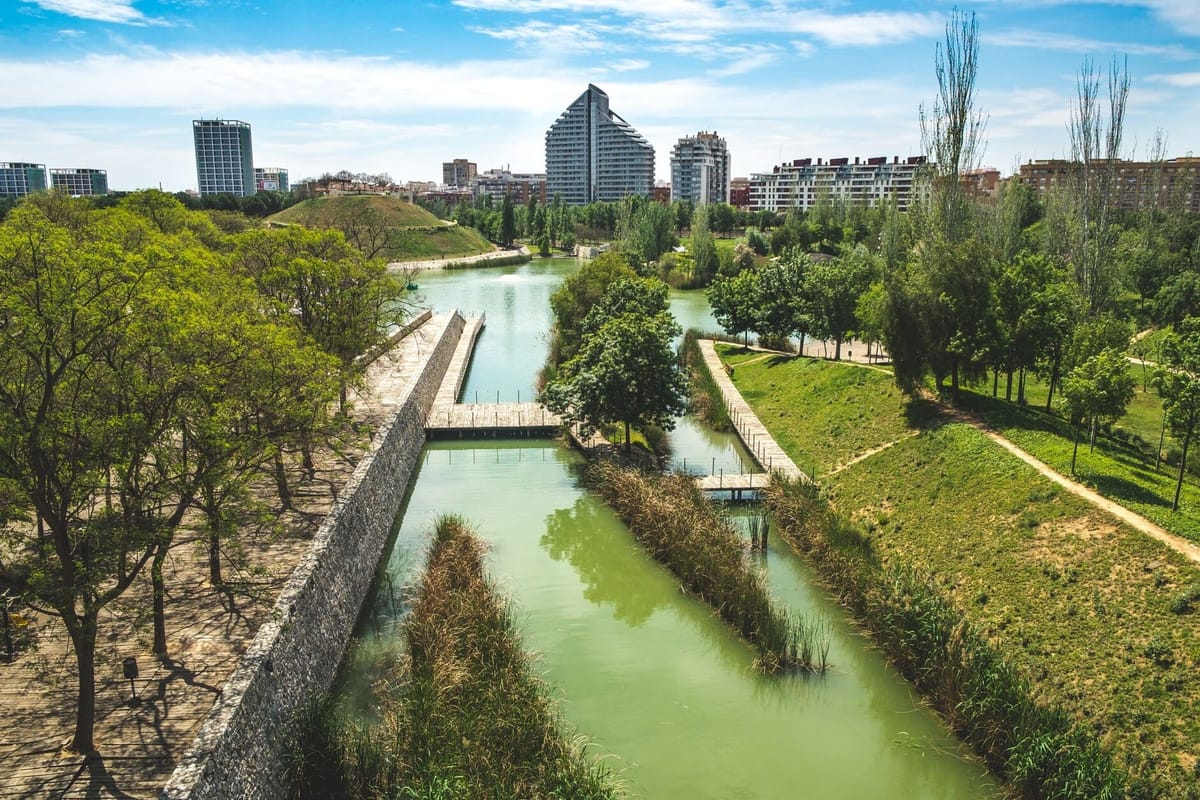
There is one thing everyone will tell you the day you unpack your bags in Valencia: the Turia is the heart of the city. Nine kilometres of greenery crossing the city from west to east, where a river once flowed. People run here, cycle, picnic, bring the children. But behind this obvious truth lies one of the finest urban stories in Europe: that of a disaster transformed, through the force of a popular movement, into an immense garden. And the story is not over, because this green ribbon is finally about to reach the sea.
A river, a tragedy
For centuries the Turia flowed through the heart of Valencia, crossed by superb stone bridges. A capricious river, which regularly overflowed. Until the founding disaster: on the night of 14 October 1957, after torrential rain, the river burst its banks and submerged the city. The great flood, the riada, killed dozens of people and left Valencia under mud. The trauma was immense, and the question became political: this must never happen again.
The response was radical. This was the Plan Sur, adopted in the early 1960s: the Turia was diverted entirely to the south of the city, into a new artificial channel skirting the metropolitan area. At the cost of a colossal project completed in the early 1970s, the river no longer crosses Valencia. What remained, right in the middle of the city, was an enormous scar: a dry riverbed several kilometres long.
"The Turia riverbed is ours"
What to do with this empty corridor? The plans of the day were unequivocal: a city motorway would run through it, to cross the city by car. This is where the turning point came. In the late 1970s, in the middle of the democratic transition, the people of Valencia took to the streets behind a slogan that has stayed famous:
"El llit del Túria és nostre i el volem verd." (The Turia riverbed is ours, and we want it green.)
The citizens' movement won. The State handed the land to the city, the motorway project was abandoned, and the decision was taken to make it a park. The design, entrusted in part to the architect Ricardo Bofill for its first sections, was carried out gradually from the 1980s. Stretch by stretch, the dead riverbed became the Turia Garden. That is what makes the place so singular: it is not a park drawn on a blank sheet, but a river returned to its people.
The garden today: everything you can do there
The result is one of the largest urban parks in Spain: nearly nine kilometres right through the centre, a succession of gardens, lawns, fountains, pine groves and play areas, all of it sunk below the city and sheltered from traffic. You enter and leave via the old bridges, which now span greenery instead of water. Here are the highlights, from west to east.
Run, walk, cycle
This is the number-one use. A wide cycle path runs the length of the garden, alongside trails for runners and walkers. It is the green axis that links a good part of the city without ever crossing a car - ideal for cycling to work, for your morning jog, or simply for crossing Valencia on foot. If you do not have a bike, the Valenbisi stations and rental shops around the park will sort you out in two minutes.
The Cabecera Park and the Bioparc
At the western end, the Cabecera Park (Parc de Capçalera) is the most landscaped part: a large lake where you can hire rowing boats, hills, shaded areas. Right next to it is the Bioparc, a new-generation zoo with no visible bars, recreating African landscapes. A classic and successful family outing.
The Gulliver, kingdom of children
It is impossible to talk about the Turia without the giant. The Gulliver is a gigantic sculpture-cum-playground depicting Swift's hero lying down, tied up by the Lilliputians: his hair, clothes and ropes are all slides and ramps that children climb to their hearts' content. Free, spectacular, and always full of laughter.
The Palau de la Música and the bridges
Heading back towards the centre, the Palau de la Música spreads its great glass canopy at the edge of the garden: classical concerts, jazz and major events in a light-filled setting. All around, the historic bridges tell the story of the old town, from the Pont del Mar to the Pont de les Flors, laden with flowers in fine weather. Look up: you are walking where the boats once passed.
The City of Arts and Sciences
At the other end, the garden ends in a futuristic flourish with the Ciutat de les Arts i les Ciències, designed by Santiago Calatrava. The Hemisfèric and its glass eye, the Science Museum, the Umbracle, the Palau de les Arts (the opera house) and above all the Oceanogràfic, the largest aquarium in Europe: this is Valencia's modern postcard, set right at the end of the old river. Whether you visit or simply admire the architecture from the pools, the place is worth the trip at any hour, and it is stunning at night.
And everything else
Between these great landmarks, the Turia is above all a vast everyday playground: sports pitches, an athletics track, picnic tables, impromptu yoga spaces at sunrise, rose gardens, and shady corners perfect for reading in the afternoon. A local tip: come early in the morning or late in the day in summer, use the fountains to cool off, and choose the western section (Cabecera) when you are after shade and quiet.
Tomorrow: the Turia to the sea
One thing is still missing from the picture, and the people of Valencia know it well: the garden stops just after the Oceanogràfic, without reaching the nearby Mediterranean. The last kilometre, towards the maritime district of Nazaret, remained for decades a no man's land wedged between the city and the port, long frozen by logistics projects. The green ribbon never reached the water.
It is this missing link that the future Parc de la Desembocadura (the estuary park) will finally fill. The winning project, named "(Con)fluir", was chosen from five proposals to design this final section and connect the Turia Garden to the Poblats Marítims, the seaside neighbourhoods.
On paper, the plan is ambitious: a little over 104,000 square metres of new space, for an investment of around 18.3 million euros, funded largely by the Port Authority of Valencia (16.2 million) and topped up by the City (2.1 million). On the menu: an urban forest in the spirit of the Rambleta park, wide meadows, a water canal, and two nods to the site - a sheet of water recalling Nazaret's old beach, lost when the port was extended, and a new giant Gulliver, this time on the theme of shipwreck. The project also plans to reopen an old footbridge to reconnect the historic heart of Nazaret with the rest of the city, and to fit out the passages under the Drassanes and Astilleros bridges, to provide a continuous cycling and walking route from the park to the shore.
As for the timetable, the definitive project entered its municipal approval phase in 2025, after being presented to the residents of Nazaret, the people most directly concerned. Beyond the figures, the stake is symbolic and restorative: to extend the great green axis all the way to the sea at last, to stitch back a long-sacrificed neighbourhood, and to give Valencia an unbroken green lung running from the water mountain of Cabecera to the waves of the Mediterranean.
Why the Turia is Valencia
If a single walk had to sum up this city, it would be this one. The Turia tells everything: the memory of a tragedy, the victory of residents who refused concrete, and that very Valencian sweetness of life that turns a scar into a garden. Whether you have just arrived or are only passing through, go down into the bed of the old river, choose a direction, and walk. Soon, you will be able to go all the way to the sea without ever leaving the green.
Sources
- Ajuntament de València - Jardí del Túria and Parc de la Desembocadura ("(Con)fluir") project
- Autoritat Portuària de València - estuary park funding
Information verified in July 2026. The Daily Valencia is an AI-assisted publication with human review; spotted a mistake? Drop us a line.
Suis-nous sur Instagram : @thedailyvalencia
Le Livre blanc 2026 de l'expat à Valencia
NIE, empadronamiento, fiscalité, école, logement : tout l'essentiel pour s'installer, réuni dans un guide PDF. Laisse ton e-mail, on te l'envoie.
🎉 Et voilà ! Ton Livre blanc 2026 de l'expat s'ouvre ici :
Ouvrir le Livre blanc 2026Dernière étape pour rejoindre l'aventure : confirme ton inscription dans l'e-mail qu'on vient de t'envoyer.
Réagis à cet article